

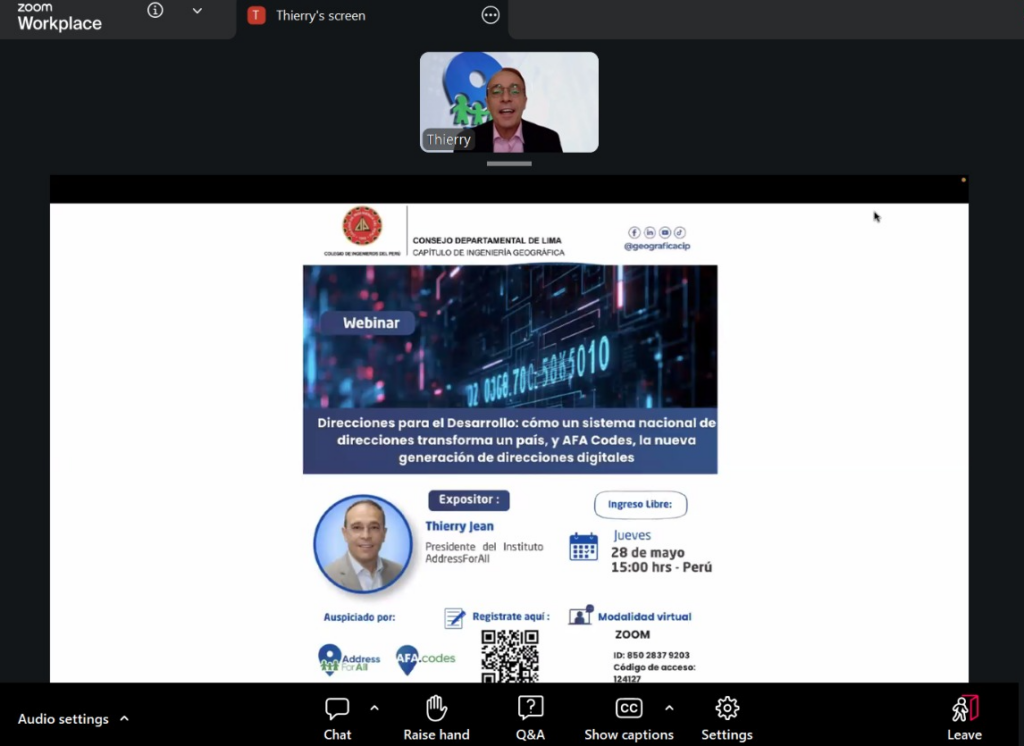
On May 28, 2026, the webinar “Addresses for Development: How a National Address System Transforms a Country, and AFA Codes, the New Generation of Digital Addresses” took place. The event was organized by the Lima Departmental Council of the College of Engineers of Peru, through its Geographical Engineering Chapter, and was led by the AddressForAll Institute.
The virtual event brought together professionals, public officials, and specialists in geography, cadaster, statistics, and territorial planning. It addressed the strategic importance of having standardized national address systems as a fundamental infrastructure for country development.
Addresses as Infrastructure for Development
Addresses are not merely tools for locating buildings, premises, and other physical elements within a territory, but also critical infrastructure that facilitates public service delivery, territorial planning, emergency management, national censuses, economic development, and interoperability among government institutions.
Several countries have made significant progress by building open, updated national address databases. This approach improves the quality of territorial data and optimizes public decision-making.
Key Takeaway: The creation of a national address infrastructure does not necessarily require waiting for specific legislation; it can begin through institutional coordination, cooperation among public agencies, and the active participation of local governments.
Public institutions were also encouraged to promote the publication of address data when it does not contain personal information. This data holds immense value for research, planning, innovation, the development of geographic applications, and evidence-based decision-making. Furthermore, the availability of this data significantly contributes to strengthening academic, cartographic, and territorial management projects.
International Experience and the Institutional Cooperation Model
During the meeting, experiences from various countries were shared, highlighting the importance of integrating information from multiple sources. Participants emphasized incorporating the local knowledge of municipalities and local authorities to keep address databases up to date.
Additionally, the presentations underscored the key role that geographic institutes, national statistics offices, cadasters, postal services, and municipal governments play in building more comprehensive, accurate, and interoperable address systems.
AFA Codes Technology: A New Generation of Digital Addresses
Another core topic was AFA Codes technology, developed by AddressForAll as an innovative solution for the geographic identification of locations.
AFA Codes allow precise geographic codes to be linked to specific locations and territorial grids, facilitating applications related to:
• Logistics
• Territorial administration
• Urban planning
• Emergency management
• Spatial analysis
This technology aims to complement traditional address systems and offer new tools for regions where conventional addresses still face limitations or low coverage.
A Space to Build Capabilities and Promote Exchange
The webinar created a space for dialogue and the exchange of experiences among professionals from different disciplines related to territorial management. It highlighted the growing relevance of addresses as a fundamental component of the digital transformation of states.
AddressForAll expressed its gratitude for the invitation from the College of Engineers of Peru and its Geographical Engineering Chapter, reaffirming the organization’s commitment to continuing to promote initiatives that strengthen national address infrastructures in Latin America and other regions of the world.
Ultimately, the event reaffirmed the region’s strong interest in moving toward more modern, interoperable, and accessible address systems capable of supporting economic development, territorial inclusion, and public management based on high-quality geographic information.

Thierry intervenes in the World Statistics Congress in The Hague (Netherlands)

What We Learned in Our Webinar on Unique and Open Address Database Projects in Countries!
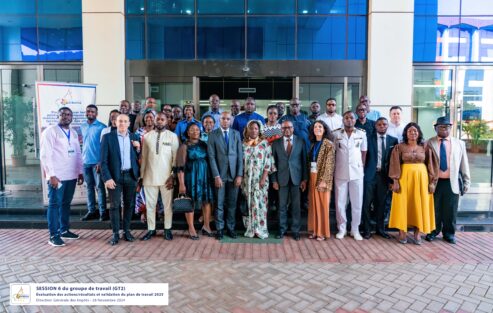
Delivering the BANOC Codes: A Landmark for Open Addressing in Cameroun
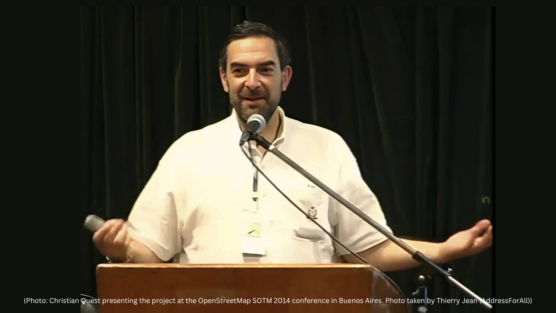
10 Years of BAN (Base Adresse Nationale): A Revolution in Address Management in France





Hey how's it going?
Can you write your comments here?